How to make text from images - Making Text From Images With Windows Paint
   
Home
 
Books
 
File Formats
 
Glossary
 
Software
 
Tutorials
     
GraphicsAcademy.com  >  Tutorials  >  Make Text From Images  >  Chapter 2

How To Make Text From Images

Chapter 2: Making Text From Images With Windows Paint

In this Chapter, I'll show you a technique to create Text from Images using the Paint accessory that comes with Windows.

You can also use similar techniques with most Painting programs.

Here's the steps:
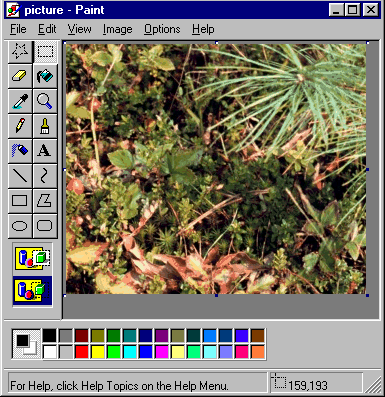
  1. First, you need a picture that you intend to use.

    Here's my picture loaded into Paint:


    If you want to know the exact size of the image in pixels, click Attributes... on the Image menu. A dialog will display with this information (you don't need to change anything, so when you're done simply click Cancel).

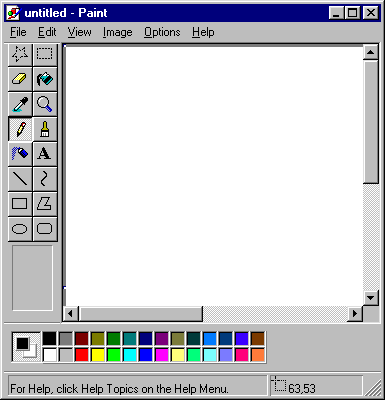
  2. Now start a second copy of the Paint accessory:


    As you can see it, it will start with a blank image.

    In a moment, we will begin drawing our text on this image, but we'll want to make sure that the text that we'll draw is smaller than the picture that we're going to use. If it helps you, you can adjust the blank image to be the exact same size as the picture, by using Attributes... on the Image menu to adjust the image size to match the image size of the picture in pixels.

    As I want to make my final image text to appear on a white background, I'm happy to start with a blank white image. If you want another color background, you can select a different color from the Color Box using the mouse, click the Fill with Color tool (it looks like the Pot of Paint pouring out), then click anywhere on the image.

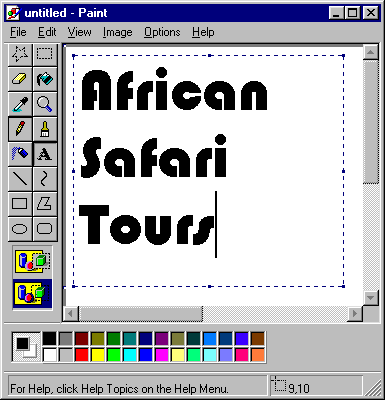
  3. Now, click on the letter 'A' button on the Tool Box.

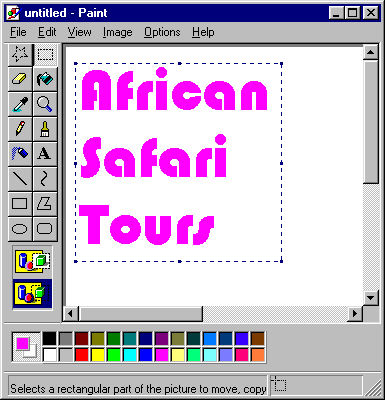
    Use the mouse to click and drag out a rectangle on the image that is easily big enough to easily enclose your text, then start typing:


  4. If you want to change the font or text size use, the floating window labelled Fonts:


    If you don't see this window, click Text Toolbar on the View menu, and it should appear.

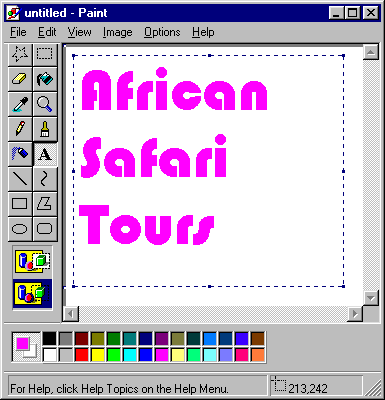
  5. We need to draw the text in a color that is not going to appear in the final image. You can do this by clicking on a suitable color in the Color Box at the bottom of the screen.

    In my example, I'm trying for an image containing leaves (mostly green) on a white background, so I picked magenta from the Color Box.


  6. Next, pick the Select tool from the Tool Box. It's the button containing a dotted rectangle.

    Then use the mouse to click and drag out a rectangle that is big enough to completely enclose all the text:


    When this is done, click Copy on the Edit menu to copy the selected rectangle to the Windows clipboard.

  7. Go back to the copy of Paint containing the picture:


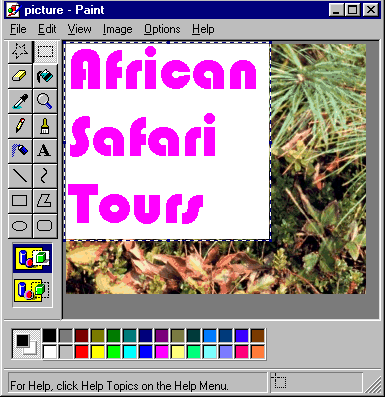
  8. Click Paste on the Edit menu:


  9. We need to make sure we are pasting in the transparent mode.

    If you look at the area of the screen just below the Tool Box buttons, you should see two little color graph-type images (with tiny blue, red and green cylinders on a yellow square). Click on the lower one to select the transparent pasting mode:


  10. We're almost there, but not quite...

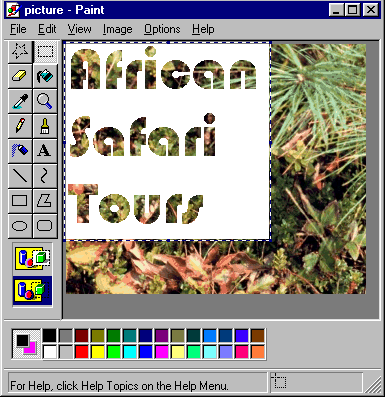
    In the last image, the background was transparent, but we want the text to be transparent.

    Right click on the color of your text, in the Color Box (in my case, magenta):


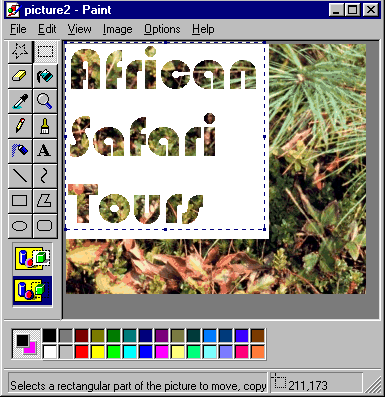
  11. If you want to position the text to use a different part of the image, you can:

    To do this, position the mouse over the dotted rectangle containing the text. The mouse pointer should change into a cross shape with arrows pointing in all four directions. You can then click and can drag the dotted rectangle (including the text) to cover a different part of the image.

  12. At this point, you may wish to save the image, so there's no chance of losing your work so far.

    If you want to do this, click Save As... on the File menu and save the picture under a file name of your choice. Do you use a different file name from the original, so that you don't overwrite your original picture.

  13. Pick the Select tool from the Tool Box. It's the button containing a dotted rectangle.

    Then use the mouse to click and drag out a rectangle that is big enough to completely enclose all the text and enough of the background as you want:


    Then click Copy on the Edit menu to copy the selected area to the Windows clipboard.

  14. Start another copy of Paint:


  15. Click Attributes... on the Edit menu, and change both the Width and Height of the image to 1 pixel, then click OK.


    Paint will now look a little odd, with a very tiny (1 by 1 pixel image).

  16. Click Paste on the Edit menu.

    A message box will appear saying "The image in the clipboard is larger than the bitmap. Would you like the bitmap enlarged?". Click Yes in response to this message.

    You should now see something like this:


  17. Use the Save As... option on the File menu, to save your work under a file name of your choice.

  18. Here's what my finished image looks like (I've added a border so that you can see exactly how big it is):


Related Software:
  • FontTwister
    FontTwister is the fastest and easiest way to create dazzling text effects. FontTwister comes with an impressive selection of templates for graphic styles, color gradients, textures, shapes, letter edges, 3-D bevels, shadows, buttons and frames. Simple intuitive controls let you interactively real-time view and select your desired effect. You can re-edit text and effects at any time. The effect generator creates unlimited variations of amazing text effects.


    Use high impact, anti-aliased text for logos, 2D and 3D headings in letters, presentations, flyers, invitations, cards, faxes, posters, web graphics, labels, banners, buttons, covers. FontTwister supports several popular image formats (.bmp, .jpg, .png, .tif, .wmf).

Web Hosting


How To Make Text From Images:
 
 
  << PreviousIntroduction   1   2   


Privacy     Terms Of Use

Copyright © 2005-2008, Answers 2000 Limited

With any business, it is up to the individual owner of said business to ensure the success of the business. You may make more or less than any sample figures or results that might be quoted on our web sites or other publications. All business involves risk, and many businesses do not succeed. Further, Answers 2000 Limited does NOT represent that any particular individual or business is typical, or that any results or experiences achieved by any particular individual/business is necessarily typical.

In Association With Amazon.com
All trademarks are property of their respective owners.
All third party content and adverts are copyright of their respective owners.

Some graphics on our web sites are Copyright (C) 1997-2000 Hemera Technologies Inc., and used under license. All such pictures are provided for viewing purposes only and are not to be saved or downloaded. All such pictures of recognizable individuals are models and used for illustrative purposes only, and not meant to imply any association or endorsement of said individual with any product or service.